

In the list the New York Times recently published of definitive American movies, There Will Be Blood comes out second.
I find this especially interesting since the movie is loosely based on Upton Sinclair’s 1927 novel about the Teapot Dome scandal, Oil , and I have been fascinated by Sinclair since a high school teacher assigned The Jungle. It is, hands down, the most impactful piece of food writing ever produced in America - and one of the reasons I became a food writer.
Sinclair wrote the book because he wanted to expose the plight of the immigrants working in appalling conditions in Chicago’s meatpacking plants. The 26- year old reporter traveled to Chicago to live undercover for almost two months in the section of the city known as Packingtown. He was truly shocked by what he found. Although he was on assignment for the socialist newspaper Appeal to Reason, Sinclair was a novelist at heart, and he felt that he could make a stronger impact by turning his findings into a fictionalized account of an immigrant worker’s life.
Sinclair’s article was serialized in the paper, but he also sold it to Macmillan as a novel. But when the publishers received the manuscript it frightened them: it was, they said, “gloom and horror unrelieved.” Little wonder, with scenes like this one about workers in the cooking room who fell into the steaming cauldrons.
“. . . the peculiar problem was that when they were fished out, there was never enough of them left to be worth exhibiting,– sometimes they would be overlooked for days till all but the bones of them had gone out to the world as Durham’s Pure Leaf Lard!”
Macmillan cancelled the contract.
Undaunted Sinclair shopped the book around. He had no takers until a young editor at Doubleday, Page and Company found the manuscript so compelling he stayed up all night reading it. Although his bosses agreed to publish it, they found the book so grisly that they sent a copy off to the Chicago Tribune requesting an opinion. Was what Sinclair had depicted, they asked, accurate? The Tribune responded with a fervent 24 page rebuttal.
But the newspaper had not asked a journalist to investigate conditions in the packing plants; they had simply turned the task over to a publicist employed by the meatpackers. And when publisher Walter Hines Page, a former journalist (and future Ambassador to Great Britain), read the report it didn’t feel right to him. So he sent his own people off to Chicago. They returned, nauseated, saying that even when Sinclair wrote that the packers routinely put out poisoned bread to keep the rat population down, and “then the rats, bread and meat would go into the hoppers together,” he had not exaggerated.
Doubleday, Page and Company published the book, which became an instant sensation. The citizens of Chicago were outraged. All eleven English-language periodicals excoriated the book, calling it fake news. The Chicago Tribune said it was “overblown fiction.” The Chicago Daily News insisted that the book was an outright lie. Meanwhile, the Chicago Public Library banned the book from its shelves.
But outside the city The Jungle was making a huge impact. It was translated into 17 languages, and when Europe nations found out about the truly stomach-churning conditions in the packing plants they banned American meat. This alarmed President Theodore Roosevelt who read the book and sent labor commissioner Charles Neill and social reformer James Reynolds to inspect the stockyards.
They returned echoing what Page’s investigators had said: the book actually downplayed the horrific conditions in the meat-packing plants. “We saw meat shoveled from filthy wooden floors, piled on tables rarely washed, pushed from room to room in rotten box carts…gathering dirt, splinters, floor filth and expectoration of tuberculous and other diseased workers,” they reported. Neill was so shocked by what he found that he refused to feed his family any meat that did not come from a local farm.
The Jungle was published in 1905; the following year Congress passed both the Meat Inspection Act and the Pure Food and Drug Act.
Upton Sinclair was deeply disappointed. “I aimed at their hearts,” he said later, “and accidentally hit them in the stomach.” What he was hoping for was better working conditions; what he got was better food.
Sinclair went on to have a very long career, publishing more than 90 novels during his lifetime. Dragon’s Teeth about the rise of Hitler in Germany, won the Pulitzer Prize in 1943.
He also entered politics, running for Governor of California in the 1934 election on a platform promising to end poverty in California. His plan? Buy up the idle factories and abandoned farms of the great depression and lease them to the unemployed.
He won 44 percent of the vote.

Eliza Acton was another revolutionary food writer of the past. A teacher and poet, she published Modern Cooking for Private Families in 1845, and changed the way recipes are written. She was the first to include a list of ingredients, write step by step directions, and include cooking times. This is one of my favorite of her recipes, slightly adapted.
Eliza Acton’s Carrots in Their Own Juice
2 pounds carrots, peeled and thinly sliced
2 tablespoons butter at room temperature
¼ cup flour
2 tablespoons chopped parsley
1/3 cup heavy cream
juice of 1 orange
salt, pepper and sugar
Bring a large pot of salted water to the boil, drop in the carrots and cook until tender about 10 minutes. Drain, reserving 1 cup of the cooking water, and run under cold water to stop the cooking.
Cream the butter with the flour in a bowl. Add the parsley and cream, mix well and add the carrot water. Stir in the carrots, return to the pot and cook for 2 minutes to thicken the sauce. Add the orange juice and season to taste with salt and pepper. If the carrots are not sweet enough, add 1/2 teaspoon (or more) of sugar.
Serves 4
Last week I mentioned the recipe for Hominy Grill’s buttermilk pie, which many people wrote in to request. It’s a lovely recipe, a classic which comes together very easily. Robert often tops it with seasonal fruit; at the moment blueberries would be perfect.
Hominy Grill Buttermilk Pie
6 tablespoons unsalted butter, room temperature
1 cup granulated sugar
2 eggs, separated
3 tablespoons all-purpose flour
1 tablespoon fresh lemon juice
1/2 teaspoon freshly grated nutmeg
1/4 teaspoon salt
1 cup buttermilk, room temperature
1 blind-baked 9-inch deep-dish pie shell
Preheat oven to 350 degrees.
In a medium bowl, combine butter and sugar until sugar is completely incorporated. Add egg yolks and mix well to combine. Add flour, lemon juice, nutmeg and salt. With the mixer running, slowly add buttermilk. Mix well and set aside.
In another bowl, whip egg whites until they form soft peaks. Pour a small amount of the buttermilk mixture into the whites. Fold gently to combine. Gently fold egg white mixture into remaining buttermilk mixture until just combined (mixture will be slightly lumpy). Pour custard into pre-baked pie shell.
Bake in the middle of the oven for about 45 to 50 minutes, until the top is lightly brown and the filling is set so that it barely jiggles in the middle.
Cool on a rack.

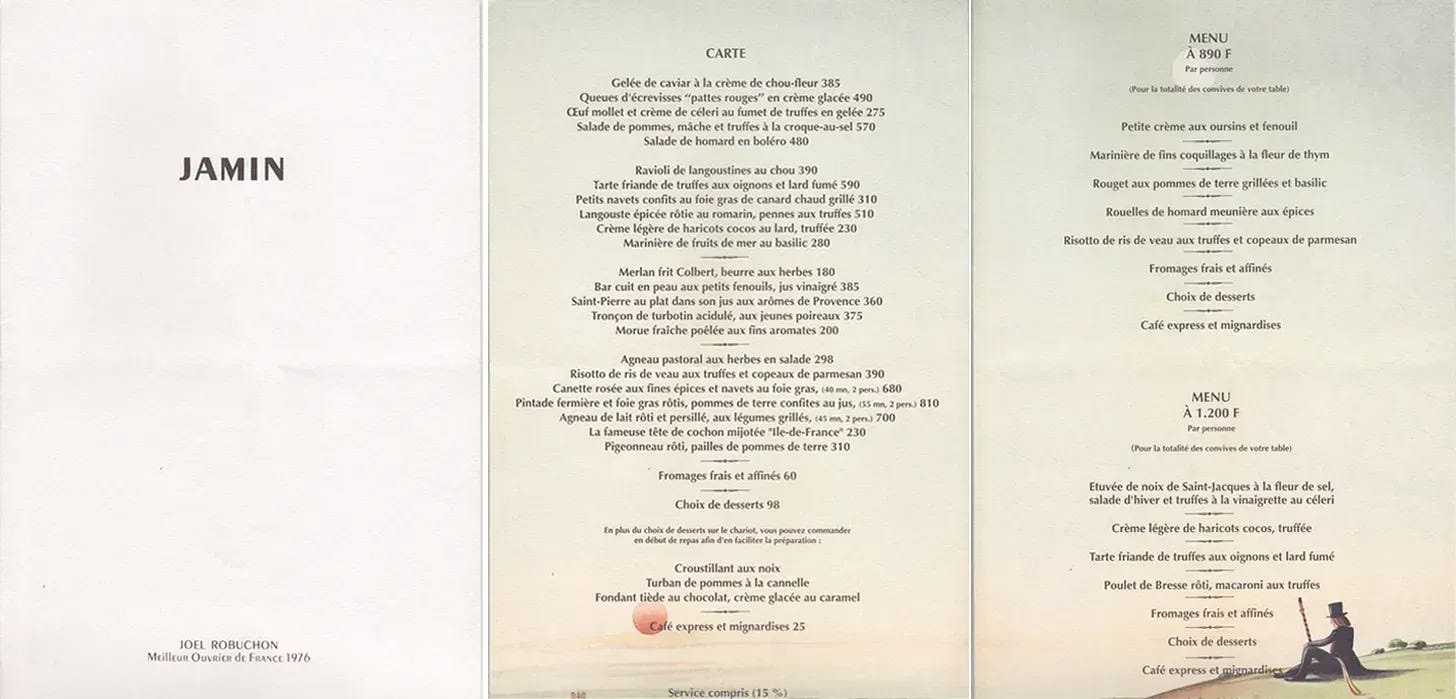

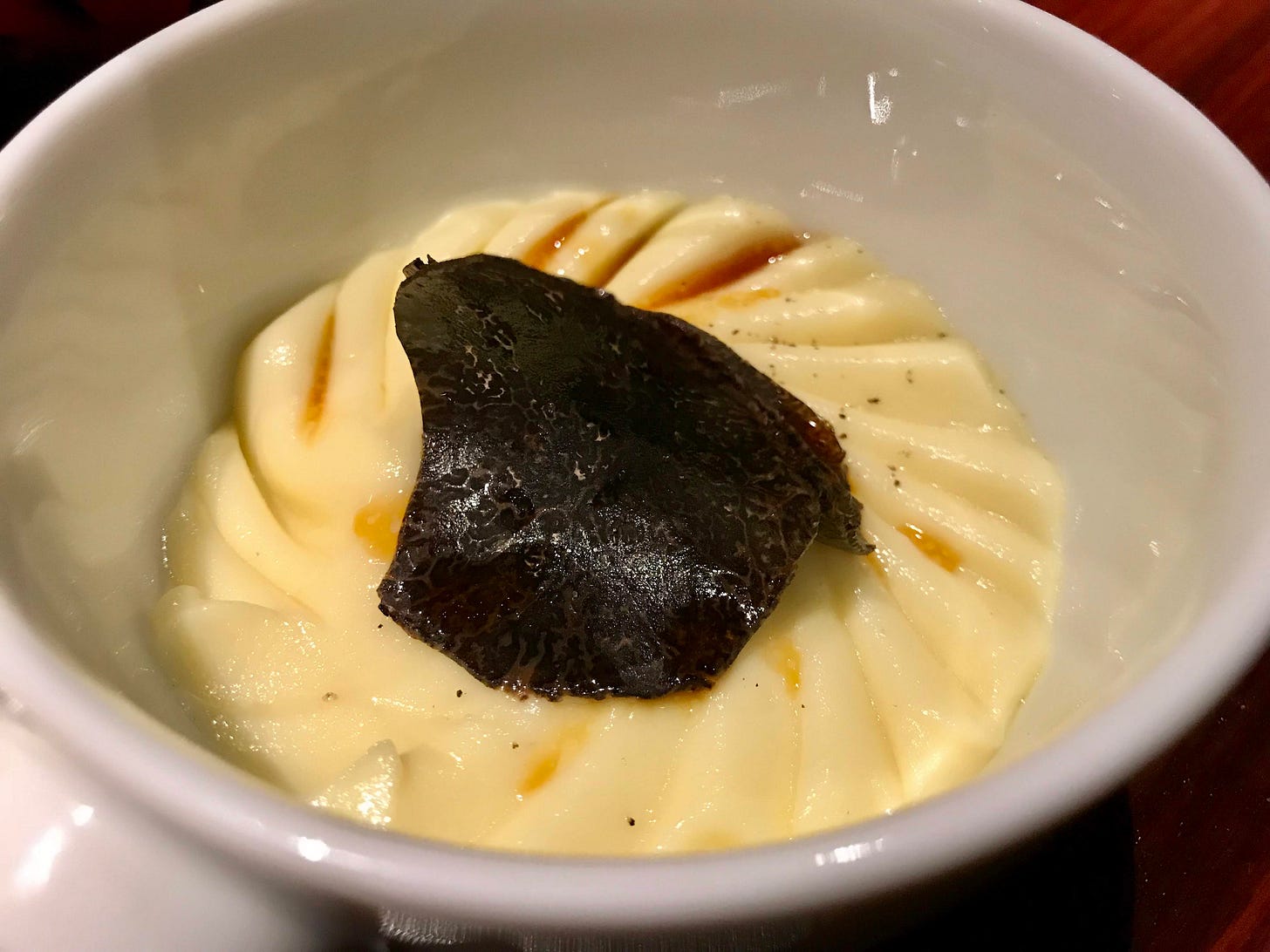
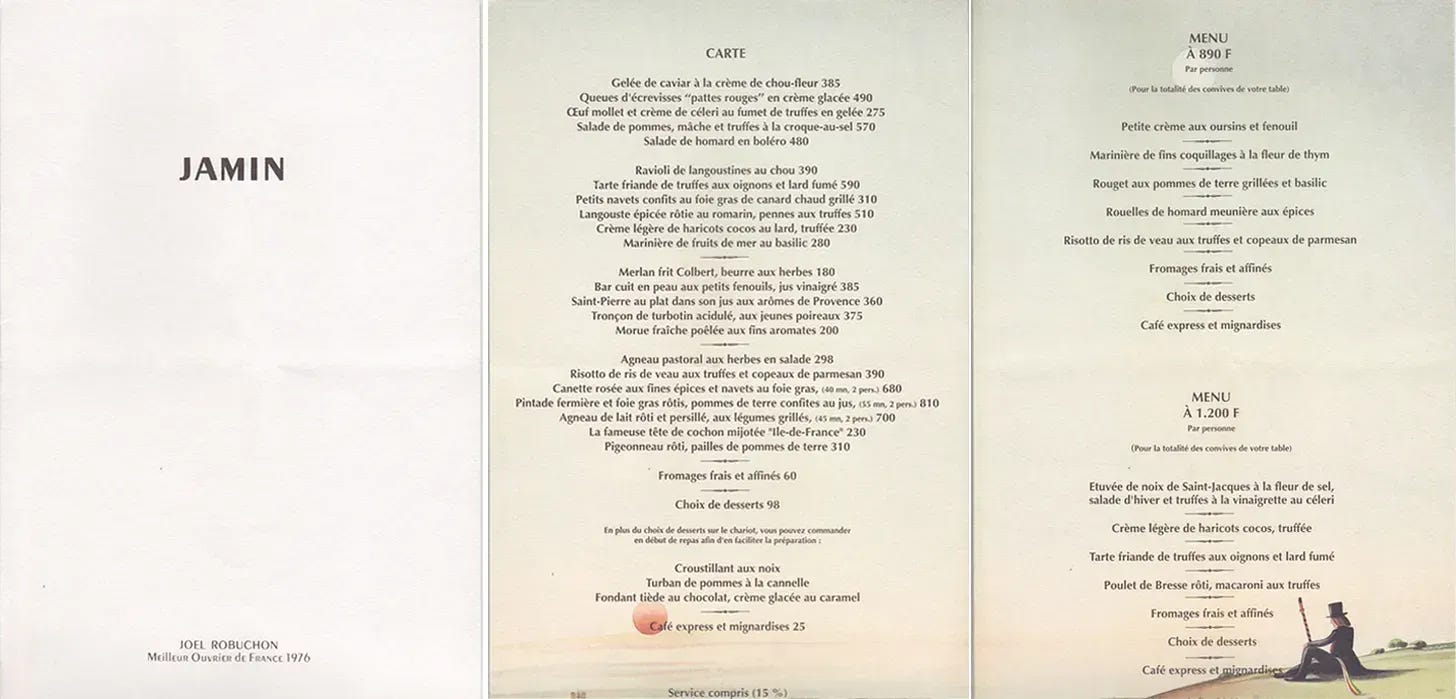
Another in a series of Memorable Meals: Jamin, Paris
1990
It takes six months to get a reservation at Jamin.
There are two reasons for this. The first is that with three stars from Michelin, and four toques and 19.5 points from Gault-Millau (their highest rating), it holds an extremely exalted status. Everybody wants to eat Joel Robuchon’s food. The second reason is that, with only 45 seats, everybody can’t.
I finally managed to get a reservation. Then, on the big night, I couldn’t get a cab. The Metro from the Ile St. Louis required so many changes that I finally ran most of the way along the Seine to the Place d’Iena, charging into the restaurant with coat flaps flying, 15 minutes late. I expected pomp, circumstance and disapproval. Instead the maitre d’ made a comical little gesture, bowed, and pointed to the only empty seat in the room. “Relax,” he murmured, bringing me a glass of champagne. I was instantly charmed.
Nothing that took place that evening caused my mood to change. Somewhere during the course of the meal, after the soupe chaude a la gelee de poule and before the petite salade champetre, I remember thinking, “This food was made by magic.” Indeed, Robuchon’s food is so extraordinary it does sometimes seem that it could not have been created by human hands.
The first course was a soup that had been turned into a custard--a sort of French version of the Japanese chawan mushi. It was, without doubt, the most intensely pleasurable soup I’ve ever eaten. “Stick your spoon straight down,” said the waiter, showing me that more riches--a sort of liquid essence of the livers -- was lurking at the bottom.
Next came another sort of soup-- etuvee de noix de St. Jacques au fumet de champignons. This seemed like a remarkably simple dish; when you looked down at the flat bowl what you saw was a frothy white liquid containing a few large rounds of scallops. But when you tasted it, there was such extraordinary intensity of flavor that I can only think that the chef cooked the dish in two steps: first the mushroom fumet, then the braised scallops. But all of the dishes I was to eat were the same; seemingly simple, they turned out to be remarkably complex.
At the next table a beautiful Japanese woman was eating alone, her pinky lifted, periodically smoothing back her long black hair. She ate with fierceness and with great concentration. When the dessert cart came, she looked at the tarts, the gateaux, the sorbets and when the waiter asked what she would like said wistfully, “All of them.”
Easy to understand, I thought, as the waiter set the next course before me. Paupiette of sole-- my least favorite fish--had real flavor. It was followed by another sleight-of-hand dish. The waiter appeared with a plate holding a perfectly white little ring made out of carefully constructed spaghetti. When you cut into the ring, you discovered that it was filled with shrimp poached to such softness that they slid down your throat. Truffles danced across the dish. How many people did it take to construct this little edifice, I wondered?
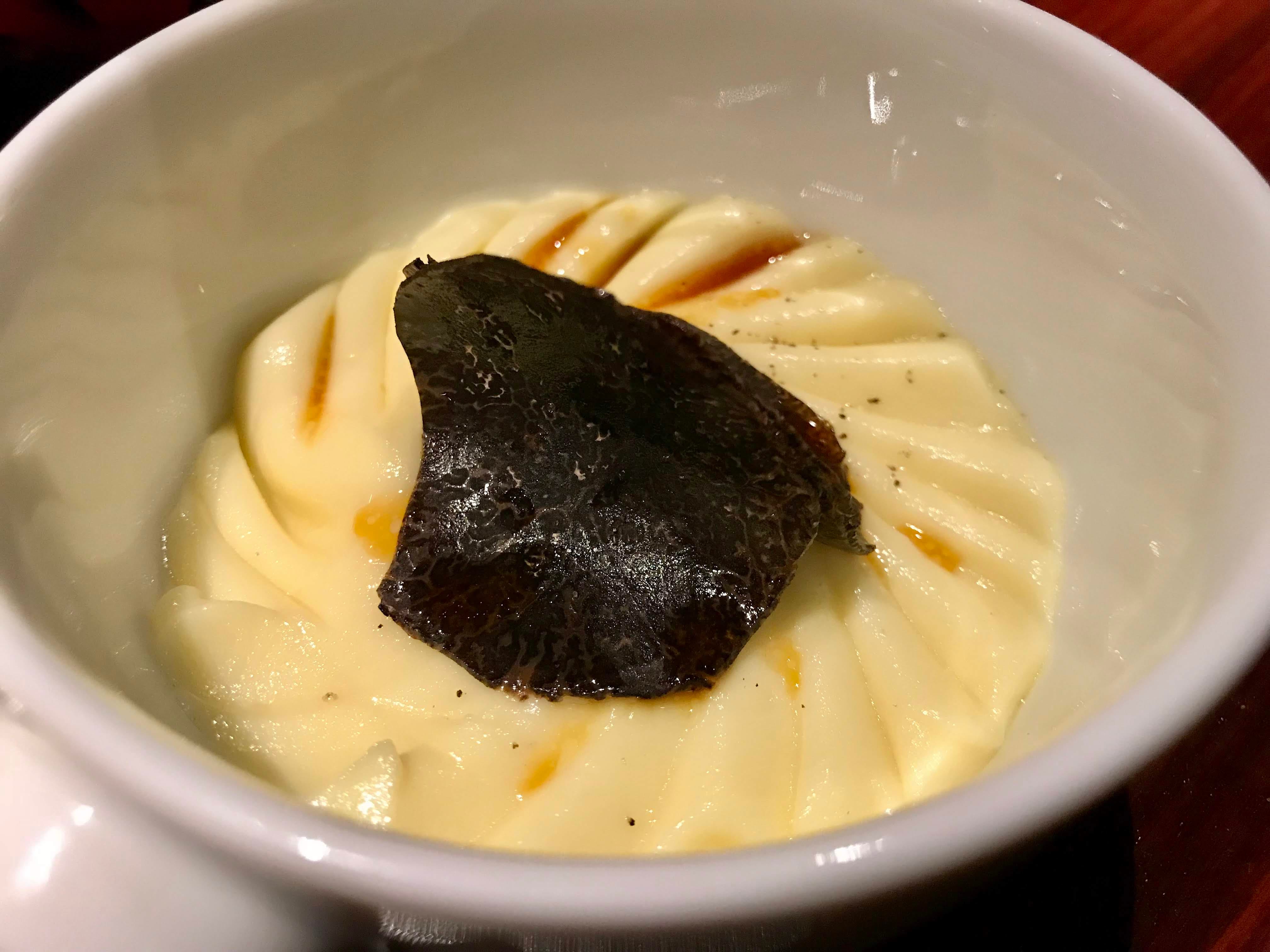
The main course-- beatilles de canard aux lentilles-- was a sort of stew of duck innards served on top of lentils, a dish for pampered peasants. With it came Robuchon’s famous potato puree--potatoes elevated to high art. There was cheese, dessert, little tidbits to eat with the coffee. But most of all there was the sense of being in the hands of a master.
Joel Robuchon is not a man who goes parading about the dining room. And his dining room itself may be the most pleasantly low-key of any great restaurant in the world. It’s the food that does the talking here--and not a single word is wasted.

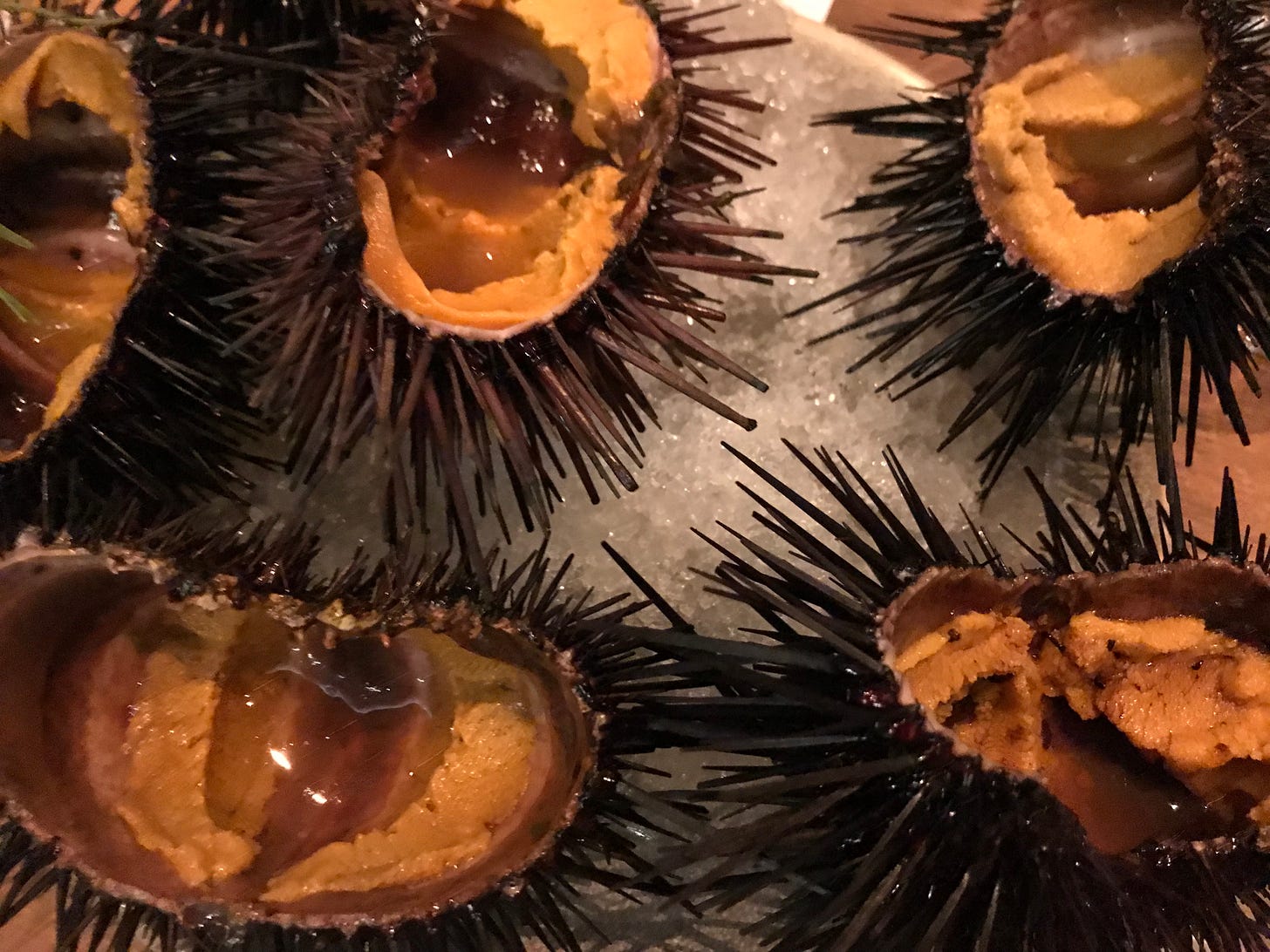
Stephanie Mutz may be the coolest woman in America. When I first met her I couldn’t help noticing that her hands were stained a deep purple, which makes sense since she is the only female sea urchin diver in the state of California - and the owner of Sea Stephanie Fish, which sells sea urchins (and other fantastic seafood) to restaurants across the country.
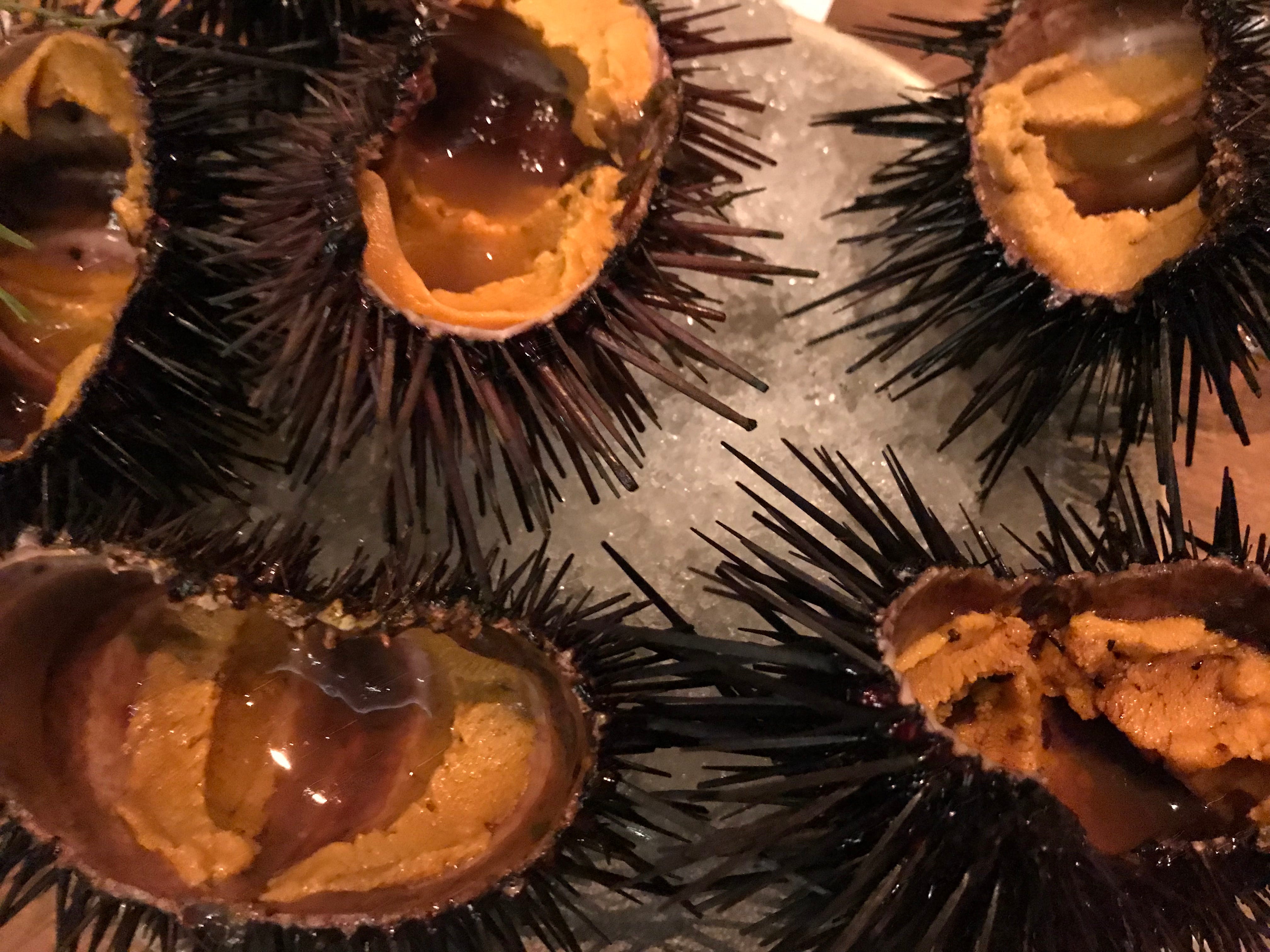
The sea urchins she sells are, in my opinion, the best in the world. (Some people prefer sea urchins from Hokkaido, but I’ll take the richer, creamier ones from Santa Barbara any day of the week.)
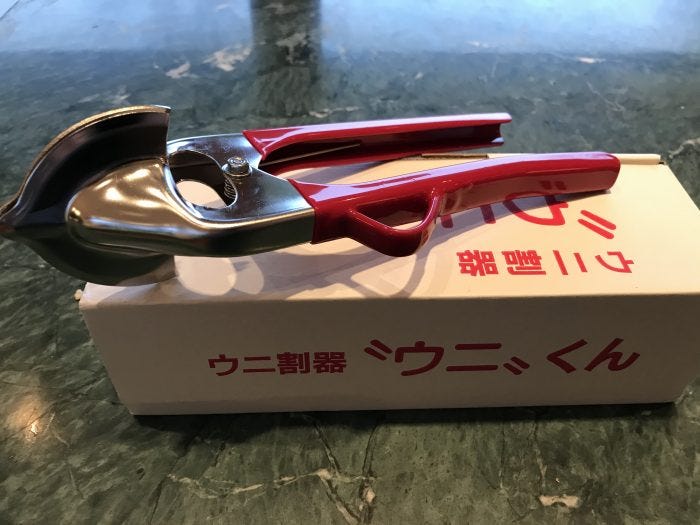
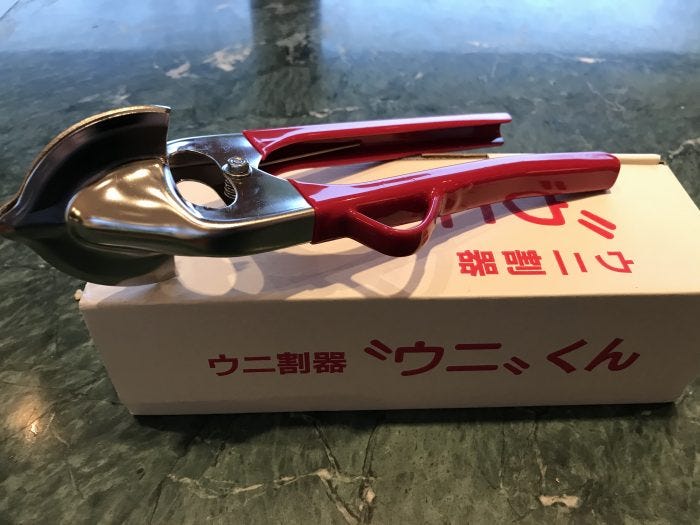
When I first fell in love with sea urchins they were a rare delicacy that few people enjoyed. Today they seem to be everywhere; fish mongers on both coasts are now selling live urchins. But if you’re buying whole sea urchins, you’re going to need to open them. Given their sharp spines and prickly exteriors, that’s not easy. Which is where this extremely functional tool comes in. Its only purpose is to open the little creatures up.
Stephanie sold me my sea urchin opener, but these days you can buy them in a number of places. Like this site on Ebay. And what sea urchin lover wouldn’t be happy to possess an opener of her very own?




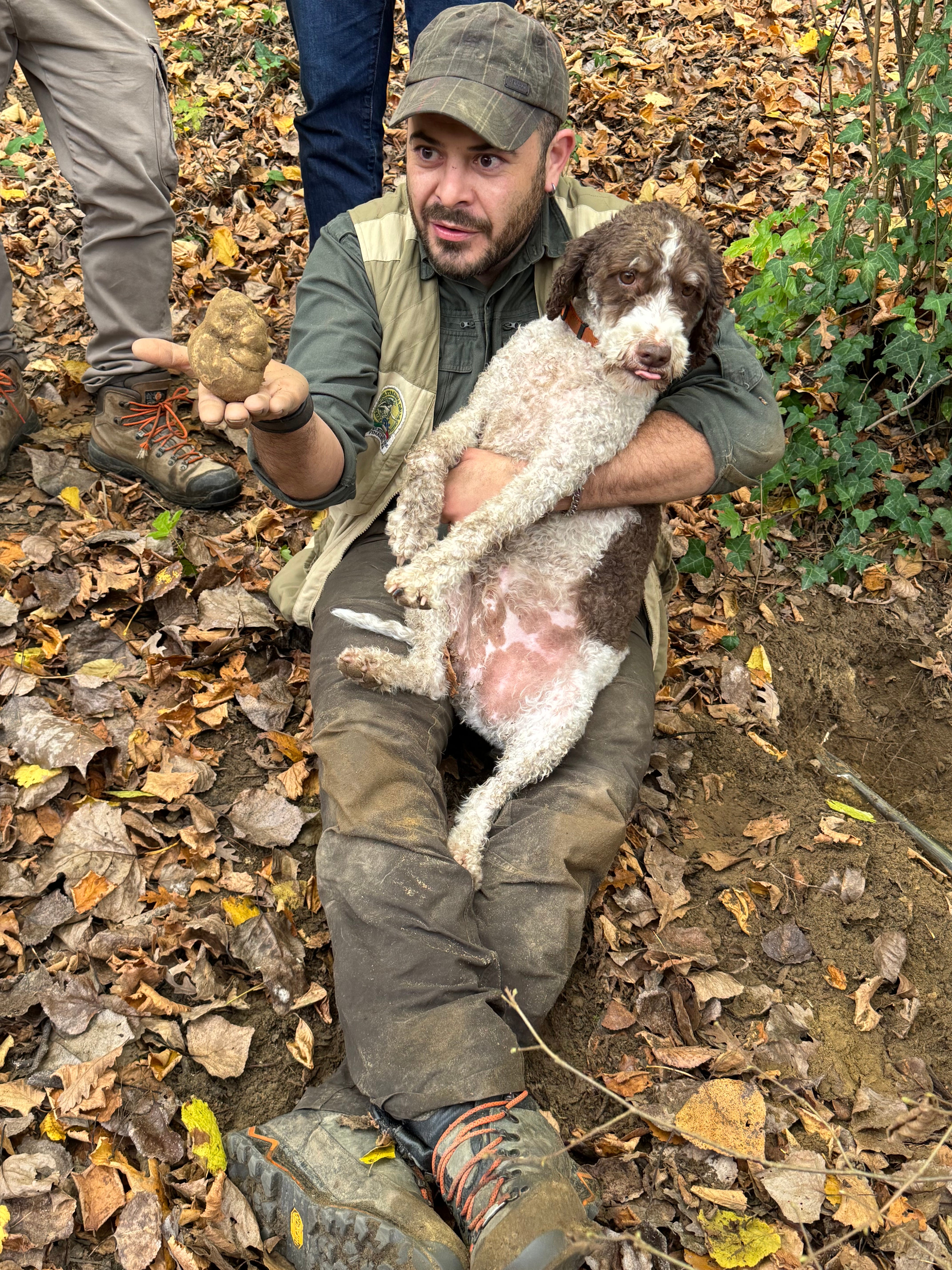
Dinner with Friends Abroad
Our fall trip sold out so quickly that we’ve added a second trip next June. There are only a few places available, so if you’re interested, act quickly. Information here.
This intimate tour begins at Nancy Silverton’s home in Panicale and then moves on to her favorite cheesemakers, olive growers, farmers, salumi artisans, chefs and truffle hunters. Along the way you will cook with local chefs and dine in both Michelin-starred restaurants and neighborhood pizzerias. Between meals you’ll explore Renaissance masterpieces in Arezzo, Assisi and Orvieto, shop in local markets… and have a lot of fun.

I read 'The Jungle" when I was in high school and again many years later. Remarkable book. And difficult to comprehend the working conditions Sinclair describes.
Thanks for the input. I think I'll read it again.
I have never heard of Upton Sinclair's book Dragon's Teeth. And it won a Pulitzer! I have just ordered it on my Kindle.